Coin
½ Penny - George V (1930) — Australia
Australia • 1930 • KM# 22, Schön# 13
Overview
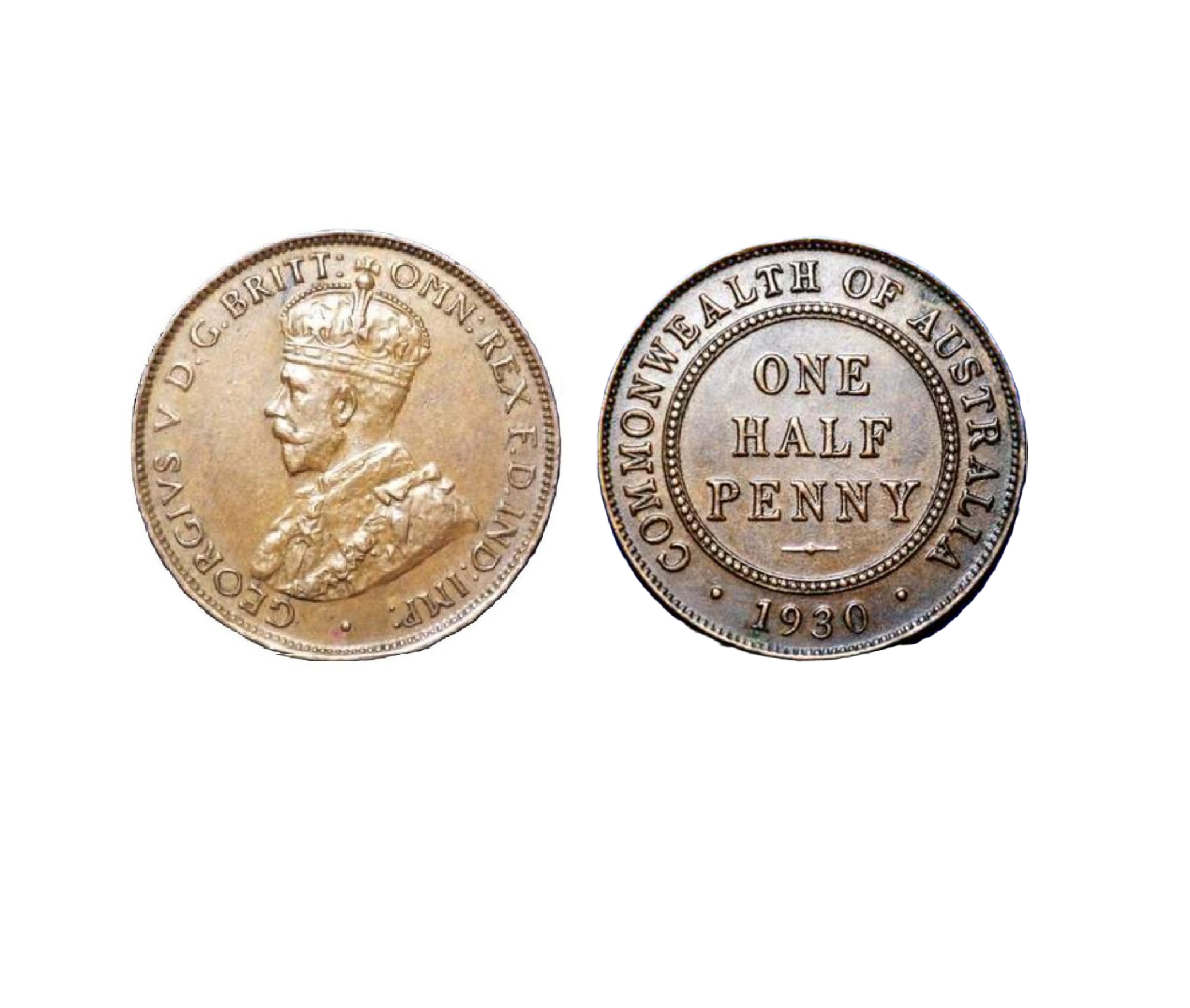
A 1930 bronze ½ Penny coin from Australia, part of the Standard circulation coins series featuring King George V. Minted at the Melbourne Mint.
Specifications
- Country
- Australia
- Year
- 1930
- Composition
- Bronze
- Weight
- 5.67 g
- Diameter
- 25.5 mm
- Thickness
- 1.7 mm
- Mint
- Royal Mint, Melbourne, Australia (1872-1969)
- Shape
- Round
- Technique
- Milled
- References
- KM# 22, Schön# 13
- Issuer
- Australia
Design details
Obverse
Crowned and robed bust of George V facing left. Lettering: GEORGIVS V D.G.BRITT: OMN:REX F.D.IND:IMP: B. M.
Reverse
In the center within a circle of beads, the words ONE HALF PENNY in three lines above a plain scroll; around the circle of beads, COMMONWEALTH OF AUSTRALIA.
Collector insights
- Design heritage: Edgar Bertram MacKennal (obverse), William Henry James Blakemore (reverse) is credited as the designer for the Standard circulation coins series. Designer attribution helps distinguish this issue from later restrikes or unofficial copies that reuse only the motif.
- Struck at: Royal Mint, Melbourne, Australia (1872-1969). Confirm the mintmark on your example before comparing prices — same-year issues from different mints often trade at very different levels.
- Mintage vs. survival: A moderate mintage of 628,000. Grade rarity is usually the driver of value here — mid-grade circulated pieces are common, but original-surface uncirculated coins can command a strong premium.
- Catalogue reference: Listed as
KM# 22, Schön# 13. Use this reference code when cross-checking auction archives, dealer inventories, and standard printed catalogues.
Curator Insights
Historical context
The 1930 Australian half penny was struck during the Great Depression, a period that saw a significant reduction in the demand for small-denomination currency due to economic stagnation. Minted at the Melbourne Mint, this issue served the pre-decimal Australian pound system which relied on British-standard specifications for heavy bronze coinage. The lower mintage of this year reflects the cautious production quotas established as the Australian economy struggled with high unemployment and reduced retail trade.
Design heritage
The obverse features the crowned and robed bust of King George V, a design by Australian sculptor Edgar Bertram MacKennal that was used across British Commonwealth territories. The reverse exhibits the classic circular bead frame designed by William Henry James Blakemore, which provides a utilitarian and symmetrical presentation of the denomination. This traditional layout remained consistent for the Australian half penny series from its inception in 1911 until the introduction of the kangaroo motif in 1938.
Varieties and technical notes
Collectors should primarily examine the alignment and clarity of the mint marks, though the Melbourne Mint did not typically utilize a distinct letter identifier for this specific issue. The edge is finished with a plain treatment, and the technical execution is standard milled coinage which often shows varying levels of circular luster. Close inspection of the scroll detail on the reverse can help distinguish between early and late state die strikes within the production run.
Survival and modern availability
With a mintage of roughly 628,000, this date is significantly scarcer than many other years in the George V series, such as 1933 or 1934. While the 1930 half penny does not reach the extreme rarity levels of its famous penny counterpart, it is still elusive in higher grades due to heavy circulation during the 1930s. Survival rates for examples in Mint State are low, as the bronze surfaces were prone to environmental oxidation and wear during their decades of active use before the 1966 decimalization.
Related pieces
More from Australia
Explore more
Browse more items in the full catalog or view Australia in the country guide.